Kaiyang Li
Ph.D. Student, Computer Science and Engineering
University of Connecticut
About
I am a Ph.D. student in Computer Science and Engineering at the University of Connecticut, advised by Prof. Shihao Ji. My research focuses on making large models more efficient to adapt and deploy: parameter-efficient fine-tuning, model merging, and compact audio-language models.
My work includes Uni-LoRA (NeurIPS 2025 Spotlight), now integrated into Hugging Face PEFT, and the Mizar family of compact audio-language models, developed during my research internship at NEC Laboratories America.
Before UConn, I worked as an Applied Scientist at Tencent Music Entertainment Group.
News
- Sep 2026Mizar and RT-OPD submitted to ICASSP 2027; models released in the Mizar collection on Hugging Face.
- Sep 2026ReForge submitted to ICLR 2027.
- Summer 2026Research intern at NEC Laboratories America (Optical Networking & Sensing), building the Mizar family of compact audio-language models.
- 2026Received the Marion and Frederick Buckman Engineering Fellowship, UConn School of Computing.
- 2025Uni-LoRA accepted to NeurIPS 2025 as a Spotlight. Received the NeurIPS 2025 Scholar Award.
Selected Publications
Full list on Google Scholar.
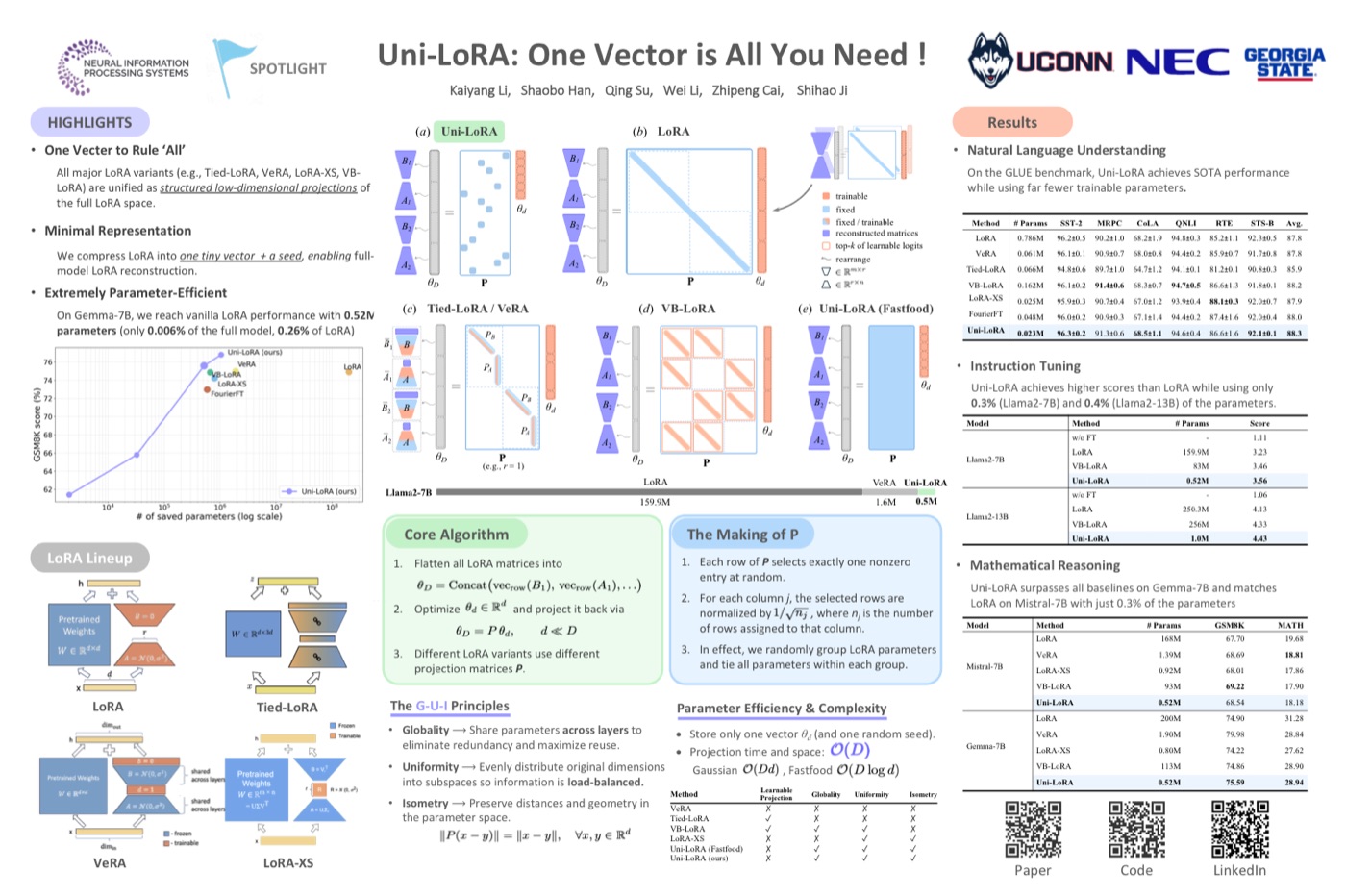
Uni-LoRA: One Vector is All You Need
NeurIPS 2025Spotlight
Reconstructs LoRA adapters from a single shared vector via an isometric projection. On Gemma-7B, achieves 75.59% on GSM8K while tuning 0.52M parameters (0.0061% of the base model). Integrated into Hugging Face PEFT.
ReForge: Refining Merged Models with Anchor-Regularized Regression
Submitted to ICLR 2027
Training-free refinement through closed-form, anchor-regularized updates and validation-guided hyperparameter search, evaluated on vision and Llama-based expert merging. In the data-assisted eight-task ViT-L/14 setting, one merged model reaches 95.1% average accuracy, close to the eight individual experts' 95.8%.
Mizar: A 159M-Parameter Audio-Language Model for Audio Understanding
Submitted to ICASSP 2027
State of the art among the evaluated sub-200M audio-language models: 52.92% on MMAU-9k with 159.3M parameters, above Google's Gemma 3n E2B (~5B total / 2B effective) and OpenAI's GPT-4o mini Audio (size undisclosed) in the paper's comparison. The paper reports a 43.78% mean across MMAU-9k, MMAR, and ADQA-clean. Results average five post-training seeds sharing one Stage 1/2 initializer.
Reward-Tilted On-Policy Distillation for Acoustic Grounding in Audio-Language Models
Submitted to ICASSP 2027
Uses audio-present/absent teacher predictions to strengthen acoustic grounding during on-policy distillation. Mizar-3B reaches 72.72% on MMAU-9k (five-seed mean), state of the art among the evaluated 3B models and above Alibaba's Qwen2.5-Omni (7B language backbone) and NVIDIA's Audio Flamingo 3 (7B language backbone) in the paper's reported comparison.
Experience
NEC Laboratories America — Research Intern, Optical Networking & Sensing
Summer 2026
Mentor: Shaobo Han
- RT-OPD / Mizar-3B: Developed audio-grounded on-policy distillation and released training code and a LoRA adapter. The paper reports 72.72% MMAU-9k accuracy after post-training on 10K examples (five-seed mean).
- Mizar-159M: Built a 159.3M-parameter audio-language model with a compact mapper and three-stage training. Measured 1.09 s mean full-answer latency on 100 MMAU questions (AMD EPYC 7542, four CPU threads, FP32, batch size 1).
Tencent Music Entertainment Group — Applied Scientist
Sep 2021 – Jul 2022
- Hit-song prediction from large-scale user behavior and audio features.
Education
University of Connecticut — Ph.D. student, Computer Science and Engineering2025 – present
University of Electronic Science and Technology of China — M.S., Electrical Engineering2016
University of Electronic Science and Technology of China — B.S., Communication Engineering2013
Honors & Service
- Marion and Frederick Buckman Engineering Fellowship, UConn School of Computing, 2026
- NeurIPS 2025 Scholar Award
- Reviewer: NeurIPS, ICLR, ICASSP, CIKM, IEEE IoT-J, IEEE TCSS, IEEE TIFS, HCC, EAAI, JIIS, AI Review, Cluster Computing
Hobbies
Hiking, reading, and Chinese food.